

When AI’s Release Velocity Outruns Its Reliability, Who Pays the Price?
Artificial intelligence companies increasingly measure progress through capability, adoption, speed, and the number of things their systems can create. Users experience another measurement entirely: whether the system is accurate, secure, reliable, consistent, and capable of completing the work it was asked to perform. As AI assumes more consequential work, shipping capability cannot become a substitute for delivering dependable outcomes.
Two Views of the Same Platform
OpenAI is moving quickly.
New models. New agents. New development tools. New ways to build applications and websites. More autonomous work. More integrations. More capabilities intended to move artificial intelligence beyond answering questions and toward completing increasingly consequential work.
That progress is real.
So is another side of the customer experience.
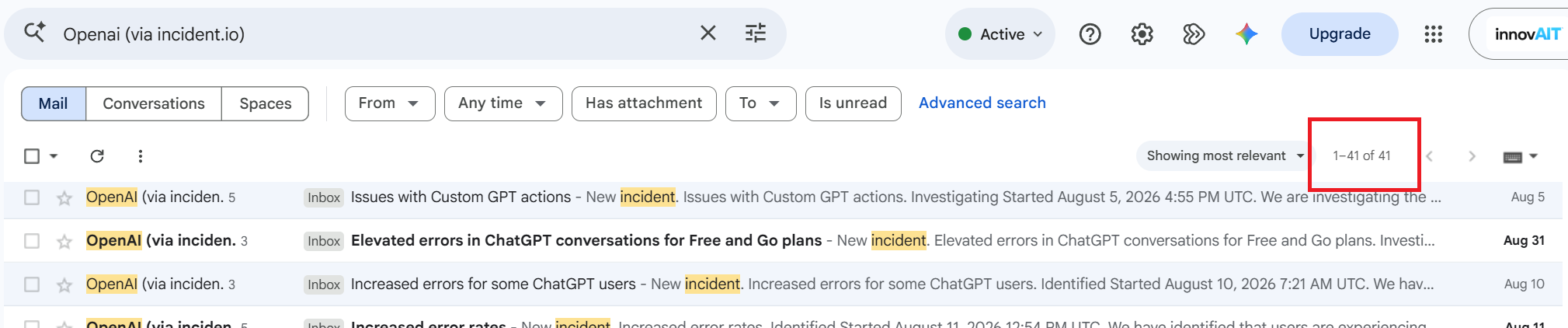
During August and September 2026, one active ChatGPT user’s inbox accumulated repeated OpenAI incident notifications. A retained Gmail search returned 41 matching messages at the time captured, after earlier notifications had already been deleted.
Those messages should not be interpreted as 41 independent platform incidents. Some messages represent updates, follow-up communications, or additional reporting associated with an underlying incident. An email inbox is not an authoritative platform-wide incident count.
OpenAI’s own public status history is the appropriate source for documenting individual service incidents.
But the inbox records something a status page cannot completely represent:
what repeated disruption looks like from the customer’s side.
What Would Happen to an Enterprise Programmer?
There is another way to evaluate repeated production disruption: apply the professional standards commonly imposed on the people who build enterprise software.
During my own work as an enterprise programmer, repeated production failures were not treated as an inevitable side effect of innovation. They carried professional consequences.
If I had personally been responsible for a comparable pattern of recordable production problems in a month, I would not have expected leadership to congratulate me for how many new features I shipped during the same period.
I would have expected scrutiny.
Root-cause analysis. Change review. Questions about testing. Questions about regression. Questions about why failures continued to recur.
Eventually, if my work continued creating production problems, I would have expected something considerably more personal:
I could have been fired.
The consequences might not have ended with that job.
My professional reputation could have been damaged. My technical judgment could have been questioned. My credibility when asking an organization to trust the next system I built could have suffered.
That accountability exists for a reason.
Production software affects other people’s work. When engineering introduces instability, the cost moves outside the engineering department through interrupted workflows, lost time, rework, recovery, and diminished confidence.
OpenAI operates at a scale and technical complexity fundamentally different from that of a single enterprise programmer. Comparing individual accountability directly with the operation of a global AI platform would therefore be incomplete.
But the underlying engineering principle still matters:
Scale should change how reliability is engineered. It should not eliminate the obligation to deliver it.
The Failures That Never Reach the Status Page
Infrastructure incidents represent only one dimension of AI reliability.
Some of the most expensive failures experienced by an AI user will never appear on a public status page.
ChatGPT can be available.
The conversation can load normally.
The model can respond immediately.
And the response can still create hours—or days—of unnecessary work.
During innovAIT development, ChatGPT has estimated that technical work could be handled in approximately 30 to 45 minutes only for the actual work, correction, testing, and verification to consume days.
The problem is not simply that software development sometimes takes longer than estimated. That is normal.
The problem emerges when a confident AI estimate materially understates the architecture, dependencies, implementation, correction, testing, deployment, and verification required to actually finish the task.
The same pattern appears in smaller tasks.
A request as narrow as changing the color of a line of text in an image has resulted in other visual elements being changed despite explicit instructions to change only the font color.
Requests for code have resulted in image generation being initiated instead.
innovAIT established Human-Adaptive Intelligence as organizational terminology, yet previously used terminology has resurfaced in later AI-generated work after the new language was already established.
Instructions not to alter an established application design have been followed by generated output that changes the design structure.
Requests for consistency across the innovAIT application suite have required additional review when components that should follow an established standard—including login and authentication implementations—were generated inconsistently.
Code has also been introduced on AI recommendation that later required examination because it was not part of an established innovAIT implementation or previously used system requirement.
These are different failure modes.
Operationally, however, they produce the same result:
The user becomes the quality-control system.
When Verification Becomes Correction
Human verification is appropriate when artificial intelligence participates in consequential work.
But there is an important difference between verifying work and repeatedly correcting failures to follow clearly established instructions.
If a user requests one font-color change and the surrounding design is altered, productivity cannot be measured at the moment the new image appears.
The time required to restore the unintended changes belongs in the productivity calculation.
If AI generates code rapidly but introduces architectural inconsistencies that later have to be identified and removed, generation speed is not the relevant end-to-end metric.
If a task represented as requiring less than an hour ultimately consumes days of user effort, the original estimate did not create productivity merely because it was delivered quickly.
And when a user must repeatedly preserve standards that were already established—terminology, authentication patterns, design structure, security boundaries, or application conventions—the AI transfers context-management work back to the person it was supposed to assist.
That begins as a verification tax.
When verification repeatedly becomes reconstruction, correction, or rework, it becomes a correction tax.
The customer pays both.
Consistency Is a Reliability Requirement
This distinction becomes increasingly important as AI moves from isolated questions into persistent professional work.
An enterprise system cannot treat every interaction as an independent creative exercise.
Once an organization establishes a standard, consistency becomes part of correctness.
If applications share an established authentication architecture, generating an incompatible implementation is not useful variation.
If a design has been locked, redesigning it without authorization is not creativity.
If organizational terminology has been established, repeatedly reverting to superseded terminology is not harmless stylistic variation.
If the user requests code, producing an image is not successful task completion.
These are failures to preserve constraints.
For enterprise AI, constraint preservation should be treated as a reliability requirement.
A useful AI collaborator should not merely understand what the user is asking now.
It should reliably distinguish between what remains open for exploration and what has already been decided.
Five Million Sites—and Errors Deploying Sites
The contrast becomes particularly visible when customer reliability evidence is placed beside public product messaging.
In a public LinkedIn post, an OpenAI employee stated that ChatGPT Sites had surpassed five million hosted sites while highlighting faster building and deployment, team editing, private site access, database visibility, and additional model capability.
That is a meaningful adoption claim.

But the customer-side record includes another relevant statement:
“Elevated errors deploying Sites.”
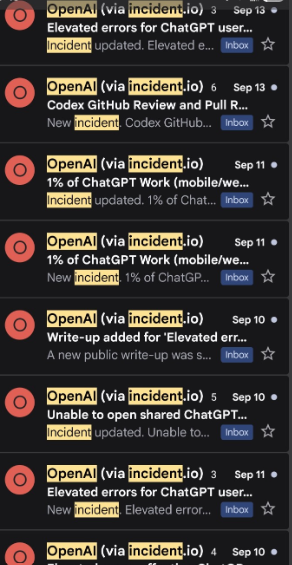
Both views can be true at the same time.
Millions of sites can be created while some deployments experience errors.
One measurement describes adoption and product velocity.
The other describes part of the operational experience encountered by customers attempting to use what was shipped.
A growth metric cannot substitute for a reliability metric.
Availability Is Not Task Completion
Traditional service availability asks whether the system responded.
AI reliability must ask a harder question:
Did the system accomplish the authorized objective?
An AI system can remain technically available while producing an inaccurate answer, losing an established constraint, selecting the wrong tool, modifying something it was explicitly instructed to preserve, or reporting completion before the requested work has actually been completed.
From an infrastructure perspective, none of those outcomes necessarily constitutes an outage.
From the user’s perspective, the task may have failed.
Worse, the user may not immediately know that it failed.
That suggests a stronger operational concept for professional AI: Task Completion Integrity.
Did the system complete the authorized objective? Was the result accurate? Were established constraints preserved? Did the system remain within its authority? Can the result be verified? And when work remained incomplete, did the system accurately report that it was incomplete?
Those measurements are more difficult than counting prompts, tokens, generated applications, or deployments.
They are also much closer to what customers actually need.
Productivity Has to Be Measured End to End
Artificial intelligence is frequently presented as a productivity technology.
That claim should be measured from instruction through verified completion.
Instruction → Execution → Validation → Correction → Verified Outcome
Suppose an AI system generates something in two minutes.
That measurement sounds impressive until the user spends an hour discovering that the output violated an established requirement, additional time determining what changed, and still more time repairing the result.
The system did not necessarily save 58 minutes.
It may simply have created work faster.
This distinction becomes more important as AI companies expand from generation into autonomous and semi-autonomous work.
OpenAI describes GPT-6 Astra as capable of computer use, browsing, software engineering, professional work, website creation, software installation and testing, troubleshooting, and other increasingly consequential tasks.
Greater capability therefore increases—not decreases—the importance of reliable completion.
Reliability Exists Inside a Larger Trust Question
These reliability questions do not exist in isolation.
OpenAI is one of the world’s most visible artificial intelligence companies, and its technology, business practices, safety measures, security posture, data practices, copyright questions, model behavior, and product reliability are regularly examined by journalists, researchers, policymakers, courts, customers, and the broader technology industry.
Scrutiny itself is not evidence that every criticism is correct. Nor should unrelated legal, safety, copyright, security, and reliability questions be collapsed into a single allegation.
But sustained scrutiny changes the importance of credibility.
A company asking customers to delegate increasingly consequential work to artificial intelligence cannot strengthen trust through capability announcements alone.
Trust is strengthened when expanding capability is accompanied by demonstrable accuracy, security, reliability, transparency, governance, and accountability.
That requirement becomes particularly important as the technology itself becomes more powerful.
OpenAI states that GPT-6 Astra is its most capable broadly deployed model and that Astra reached the company’s Critical cybersecurity capability threshold under its Preparedness Framework.
That is an important capability milestone.
It is also an illustration of why operational discipline must keep pace with technical capability.
The Standard Should Scale Up, Not Down
None of this argues that OpenAI should stop developing new products.
It argues that operational discipline should advance alongside technical ambition.
A chatbot answering a casual question presents one level of consequence. A system writing production code presents another. An agent interacting with external systems presents another. AI building applications, conducting research, operating computers, or executing multi-step professional workflows creates still greater expectations.
More authority requires more reliability.
There is a strange inversion when an individual engineer can face serious professional consequences for repeatedly introducing unreliable software into production while, at industry scale, enormous release velocity can itself become evidence of success even when customers are absorbing repeated disruption and correction costs.
Those standards should move in the opposite direction.
A company should not receive a lower engineering standard simply because its individual engineers would face a higher one.
The greater the reach of the system, the greater the potential cost of failure.
The more authority users delegate, the greater the obligation to preserve reliability.
The more loudly an organization markets productivity, the more seriously it should measure the time customers lose to verification, correction, rework, and recovery.
A feature is not successful merely because it launched.
A model is not productive merely because it generated something quickly.
An agent is not autonomous merely because it started a task.
And millions of deployments are not the same thing as millions of successful outcomes.
AI companies are measuring how quickly intelligence can create things. Users are increasingly measuring how reliably those things finish the job.
Those are not the same metric.
OpenAI is an appropriate case study precisely because its technical ambition is substantial.
It wants AI to do more.
Its users are being invited to entrust it with more.
That makes reliability criticism more relevant, not less.
OpenAI does not need fewer ambitions.
Its operational discipline needs to keep pace with them.
Because users do not experience artificial intelligence as a product roadmap.
They experience whether the work gets done.
The next breakthrough AI users need may not be another feature. It may simply be one that finishes the job.
Sources
- OpenAI, OpenAI Status — History, accessed September 14, 2026. https://status.openai.com/history
- OpenAI, Elevated errors affecting ChatGPT Work, September 10, 2026. https://status.openai.com/incidents/01M26DX2PP1AFHGJK5E4M6S2J6
- OpenAI, 1% of ChatGPT Work (mobile/web) turns are failing for existing threads, September 11–12, 2026. https://status.openai.com/incidents/01M28MEQWTQJDRCRPFD9FWQ0H3
- OpenAI, Elevated errors for ChatGPT users in Europe, September 13, 2026. https://status.openai.com/incidents/srqgkjy9
- OpenAI, GPT-6 Astra: A new generation of intelligence, September 2026. https://openai.com/index/gpt-6-astra/
- OpenAI, Safety overview: GPT-6 Astra, September 3, 2026. https://openai.com/index/safety-overview-gpt-6-astra/
- Jon Abrams, OpenAI, Public LinkedIn post discussing ChatGPT Sites adoption and product capabilities, September 2026. Referenced in Figure 2.
- innovAIT SE, LLC, User-retained OpenAI incident notification record, August–September 2026. Referenced in Figures 1 and 3.